> A Home Is a House You Leave <
Solo exhibition, Kunstpakhuset, Ikast. 2025
”(…) why even write? To postpone death, to win back one’s beloved, to capture and immortalize moments that otherwise would have been lost forever, and conversely, perhaps to get rid of other moments in the hope that they will not haunt one for all eternity.”
Søren Ulrik Thomsen
”Store Kongensgade 23”
(2021)
The above quotation also applies to me. In particular, I think the final sentence hits the mark. That basically I write and create visual art in order to rid myself of moments—or rather memories. And precisely memory is the driving force of my solo exhibition > A Home Is a House You Leave < at Kunstpakhuset in Ikast. I also reflect on what difficult memories do to me, these relived experiences of anxiety, loneliness, betrayal, and horror. But in this work it’s not only about getting rid of them, but also about holding onto, transforming, and reinterpreting what has shaped me. And I wonder whether moving the memories forward—carrying them on—insightfully—yet without becoming powerless. How? The answer is: with the help of art and “together with others.”
For Kunstpakhuset I am creating a site-specific exhibition where memories are central. The most prominent themes are my vulnerable mind and childhood memories of anxiety, of feeling invisible and lonely, and of longing for closeness and care. It concerns both personal and collective memory.
The exhibition comprises four installations:
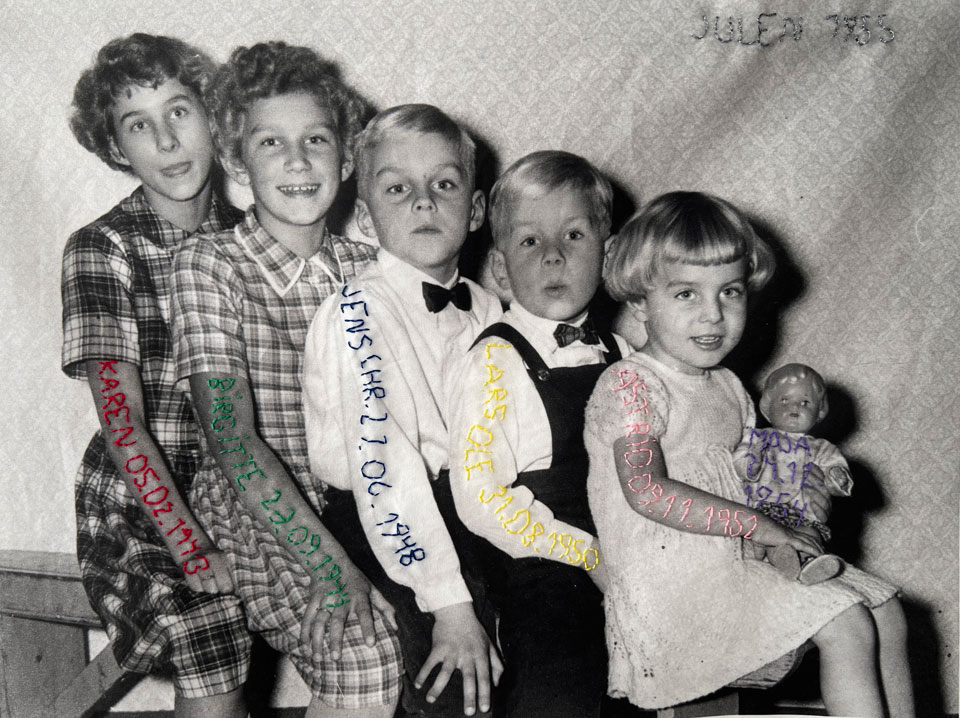
“Rewrite History” is the first installation. Here I have taken as a starting point my mother’s photo album, which she made for all seven of us siblings. My mother was both a photographer and active in the darkroom, and her albums are marked by care and an eye for detail. I have selected photos, enlarged them onto fabric and processed them, so they now bear short texts that I have embroidered directly into the surface of the image. The texts spring from my own memories, but they are transformed and edited, so they both reveal and conceal, both preserve and rewrite. In this way the images become an investigation of how history and memory are always in motion, always under negotiation.
The second part is > Notes on Solitude <. It consists of white handkerchiefs hand-embroidered with words or texts inserted in the context: loneliness. The texts examine, delineate, and circumscribe this human condition. They are poetic, polysemous texts that have emerged from my inquiries, and which are partly my own texts, partly sampled. These notes are retained through the process: hand embroidery on a physical, sensory material: handkerchiefs. To embroider is an intensely present act and is regarded by most as a totally useless and time-consuming activity. The feminine as a bridge to the other. In the same way the handkerchiefs carry meanings of the feminine and of time from a time when for bourgeois women it was endless. And with sorrow as unavoidable and visible. I have chosen to embroider with a running stitch, which is a very simple form of embroidery. Not a fine, finished, perfect embroidery, but more like a hesitant, insecure fumbling forward. These handkerchiefs hang individually, freely movable at eye level, and their upper edge creates a unifying horizontal line in the room, while at the same time they blur it, and they hang so close that one can only move around with great attention. Through them one can see:
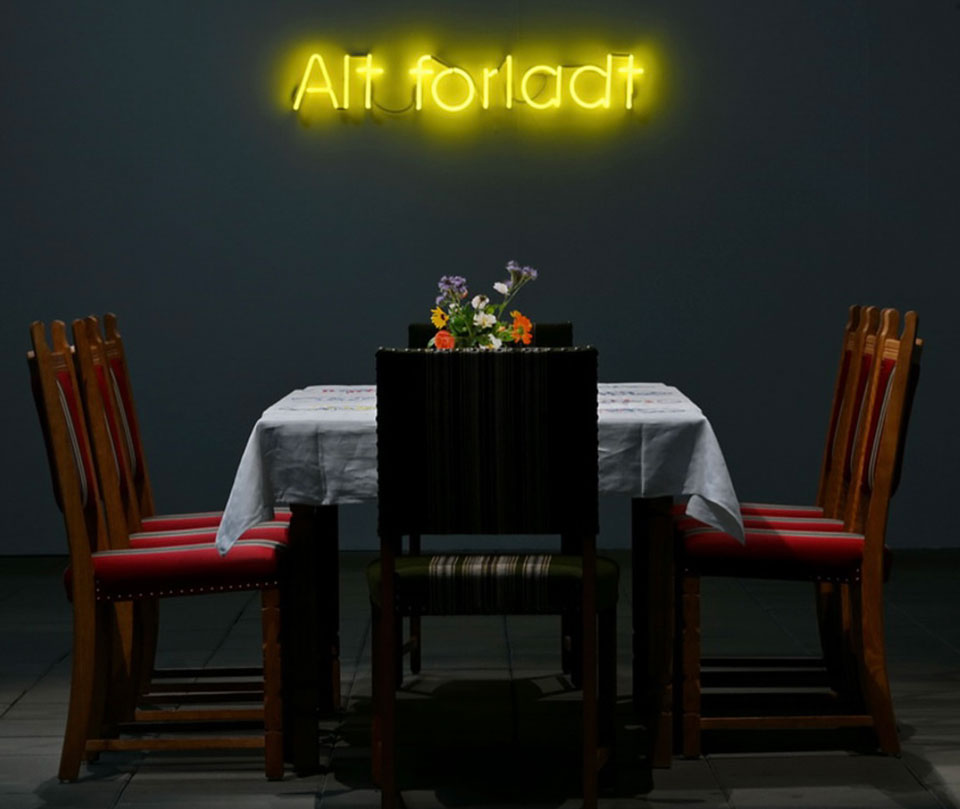
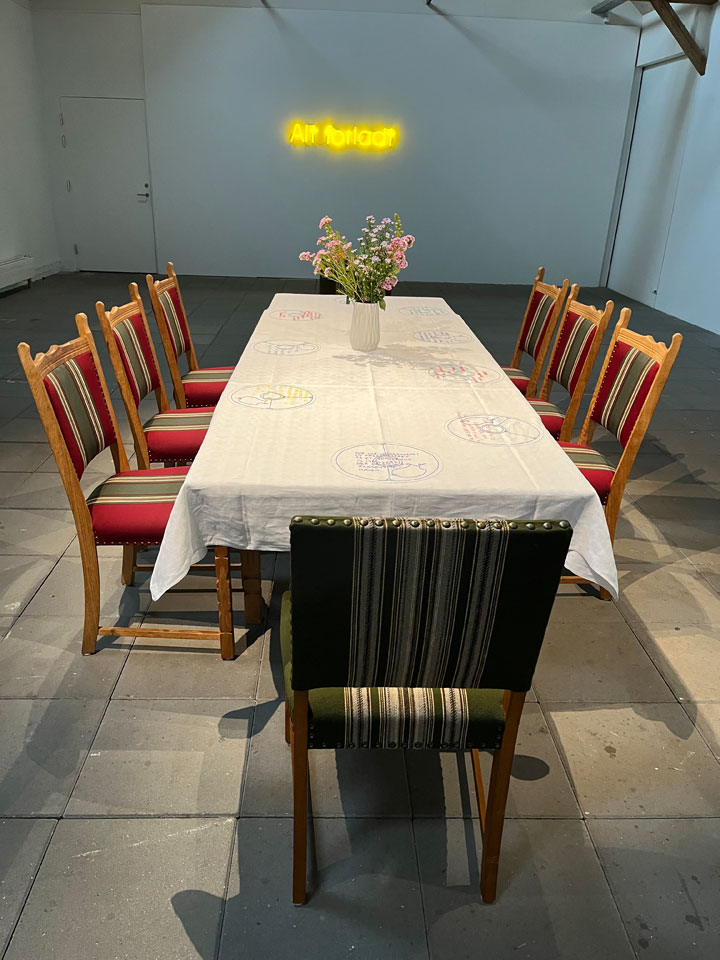
The third installation > Sunday Dinner <, which takes its starting point from the family’s shared space: the dining table. The table is laid for nine people, but there are only eight chairs. The absence is felt in the gaze and in the body. On the table lies my mother’s beautiful linen damask cloth, on which I have embroidered nine plates with mussel-patterned motifs. On top of the motifs I have embroidered episodes from my life. They are texts about what is not spoken—everything unsaid that nevertheless sits between people at a meal. Occasionally the table hymn “All Good Gifts” can be heard. This installation points both to community and to the painful experience of exclusion, to all that remains hidden even when we gather.
The fourth and central work is the neon installation > All Abandoned <. The yellow light fills the long back wall and acts as an anchor for the entire exhibition. All the other works relate to this statement, which can be read both as a personal experience and as a universal human truth. The neon light creates a presence that is both insistent and fragile, casting its glow over the other installations.
*
The first installation is ”Rewrite History”
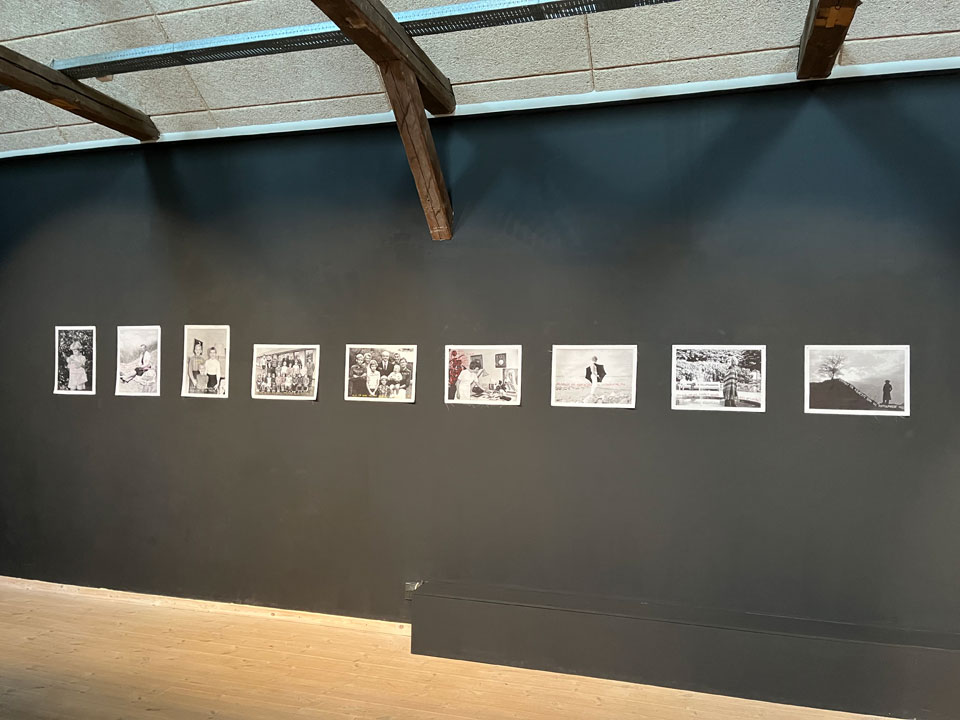
”Rewrite History”, detail.
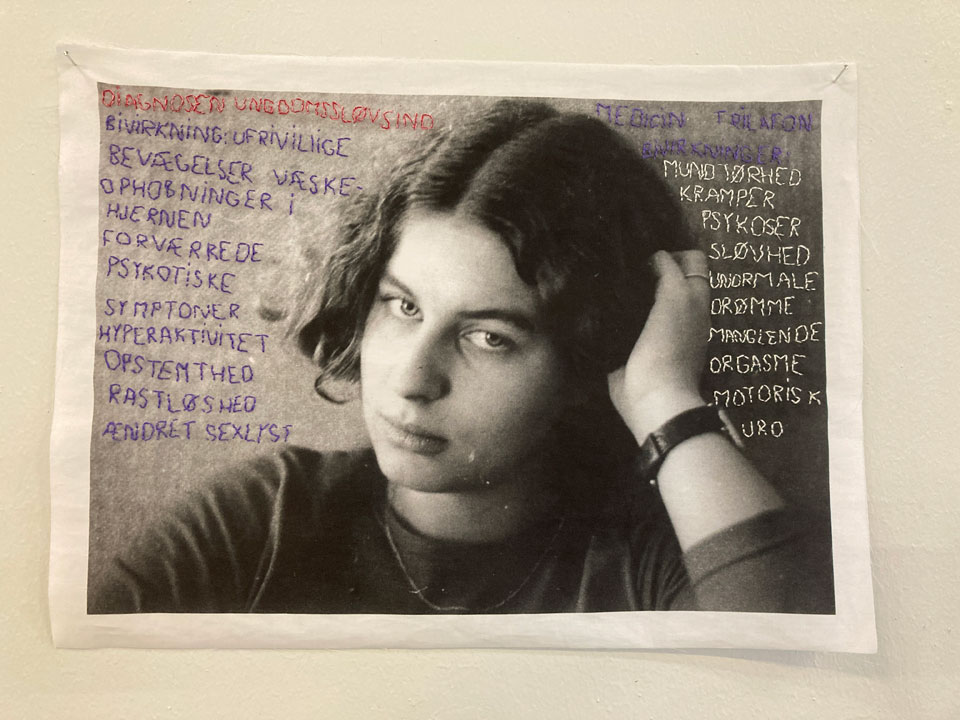
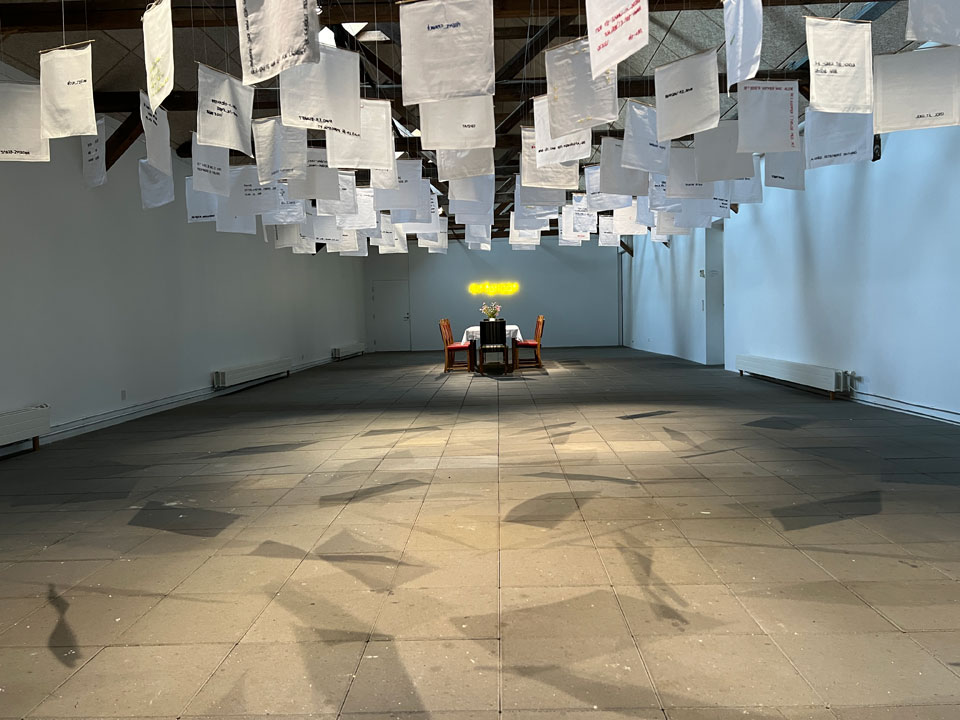
The second installation is > Notes on Solitude <
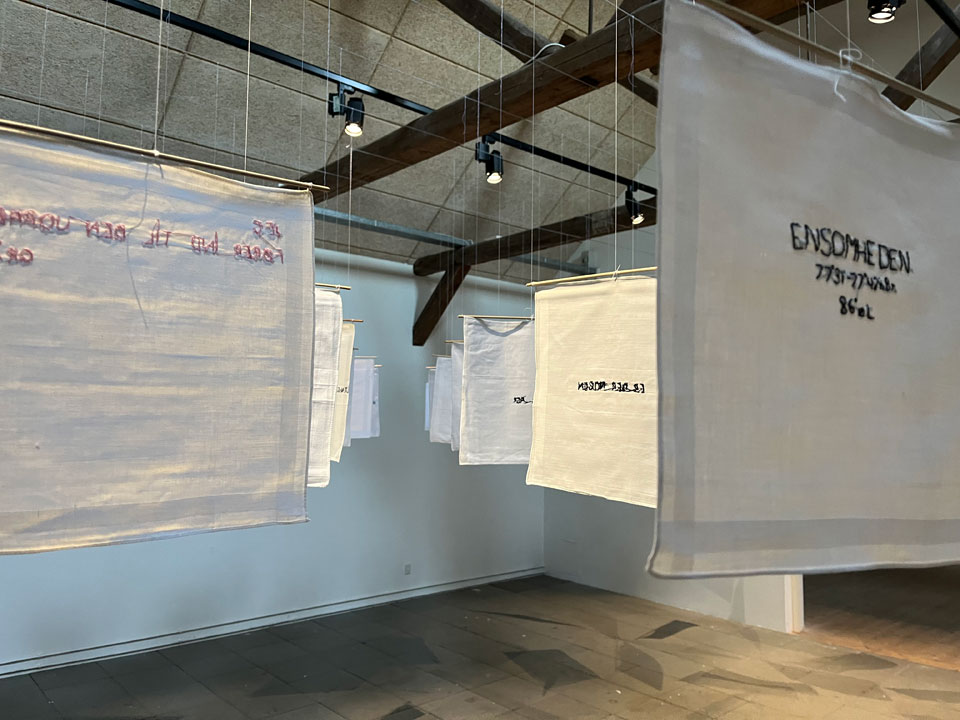
> Notes on Solitude <. detail
The third installation is > Sunday Dinner <
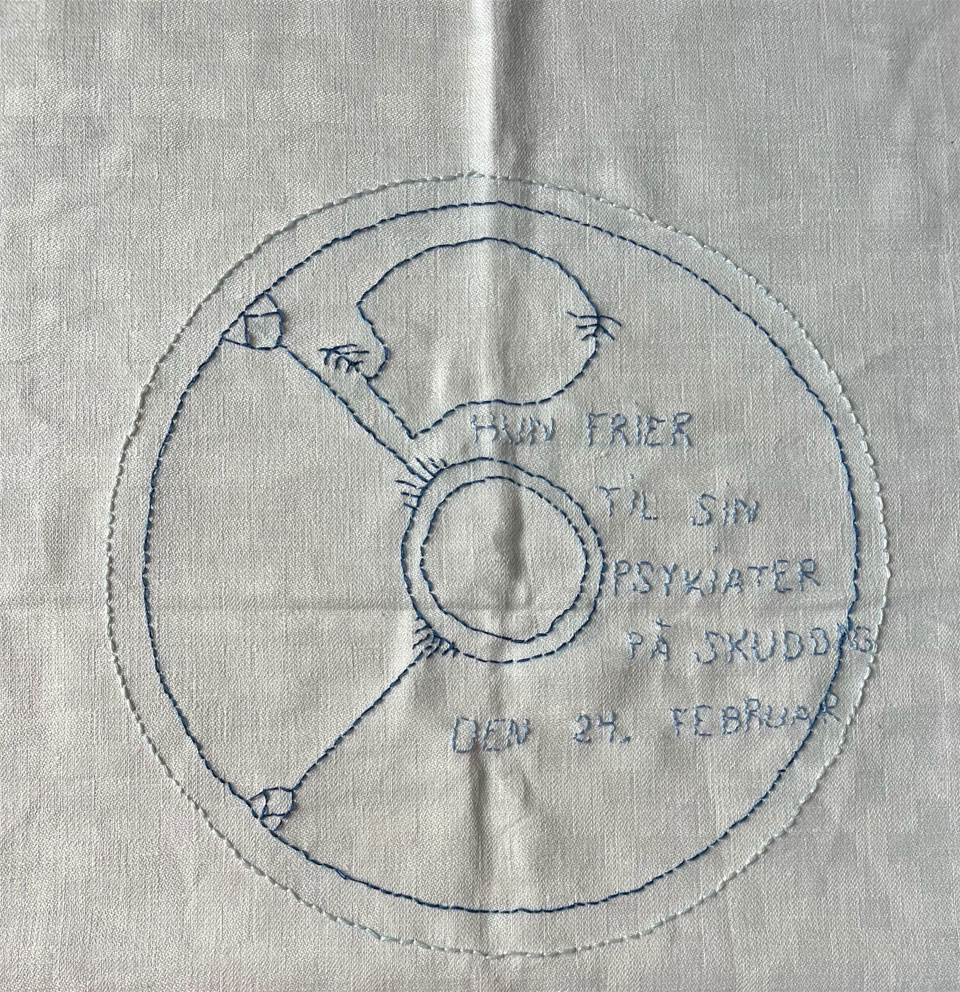
”Sunday Dinner”, detail
The fourth and central work is the neon installation > Everything Abandoned < (in Danish the double meaning ”Alt forladt”)