"Emil's Diary"
The exhibition "Emil's Diary" in the SE! exhibition and project space.
When Astrid Gjesing first visited the State Library and read Emil's diary, she was deeply captivated by it. Emil Kjærsgaard, "Østergaard," Løvel, was a man of few words. He was a farmer, a smallholder in Løvel, north of Viborg, with a daily life limited by work, but evenings and Sundays filled with time spent with close and distant family, with neighbors, and with a broad circle of acquaintances. He wrote every day in the period from January 14, 1944 to April 15, 1951. For example:
• February 3. The weather fairly good with light frost. Work on various small tasks in the morning. Visited Mejeribestyrer Mikkelsens in the evening.
• April 15. The weather fairly good. Work. Jævnet Kule. The weather in Viborg for a funeral with Uncle Chr. Jensen's wife.
Emil's diary appears simple, repetitive, stagnant, dull—but almost a kind of haiku. It captivates. It is a lived life. It is time.
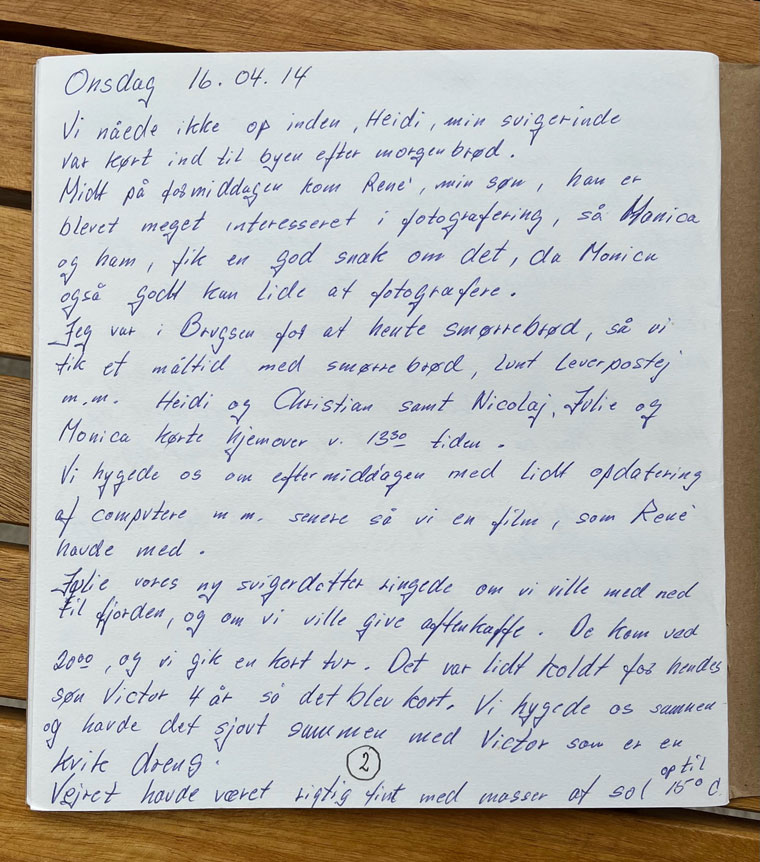
This experience sparked an idea. Astrid wanted to write to a number of Emil(s) and ask them if they would keep a diary for her for one month. She chose to write—by hand—letters to 105 Emil(s) spread across the country and from rural areas and cities. From them she obtained a rich body of material consisting of 9 diaries. Of these, she has visited 5 diary authors and had them read their diaries aloud. She recorded it, and from that came a remarkable and rich material.
Anne Neimann Clement is a cultural mediator and audio producer who, in the last 10 years, has specialized in presenting art through sound. We have collaborated on "Emil's Diary" in a podcast. It consists of an interview with Astrid about the idea and execution of the project, with audio samples from the five readings.
The podcast is published in collaboration with the contemporary art portal Art Matter, which each month is visited by 55,000–60,000 unique users, and highlighted in their newsletter, which each week is sent to 15,000 recipients.
The diary is a very democratic art form. Many have at some points in their lives written a diary themselves. Everyone knows what a diary is. In the diary, the day is frozen, otherwise it would disappear into oblivion. The small things become meaningful. They gain weight.
The diary invites us to be observant and to pause for a moment. As the pages fill, the diary becomes the documentation of a lived life. It shows connections, shifts, highlights significant events, and lets other things stand between the lines. In "Emil's Diary," the universal is elevated to art and the private becomes public. It is a process that requires gentleness and care for the people who have agreed to participate, and openness from the people who see and listen.