"Om sorg" (”About Grief”) Sct. Hans Have, Roskilde
Audiowalk created by visual artist Astrid Gjesing and composer Sisse Lunøe for Sct. Hans Have near the Psychiatric Hospital, Roskilde.
It is a work for 6 female voices. Participants: Anne Dyhr, Rose Wiesner, Golshid Rakhzan, Amalie Vilslev Juelsgaard, Kirsten Vase, and Astrid Gjesing.
Audiowalk overview
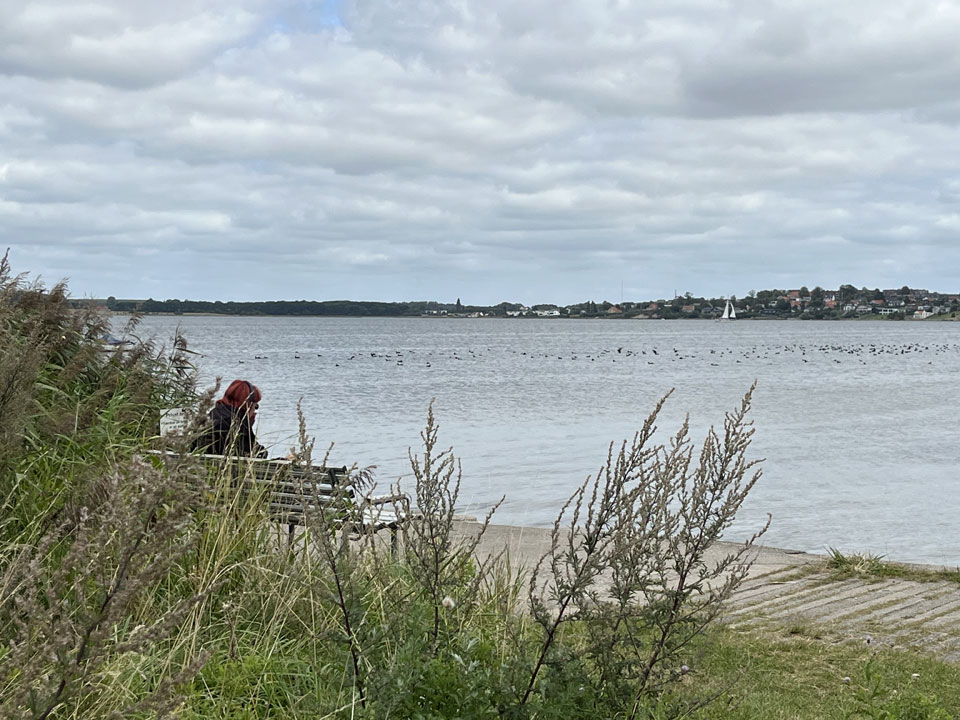
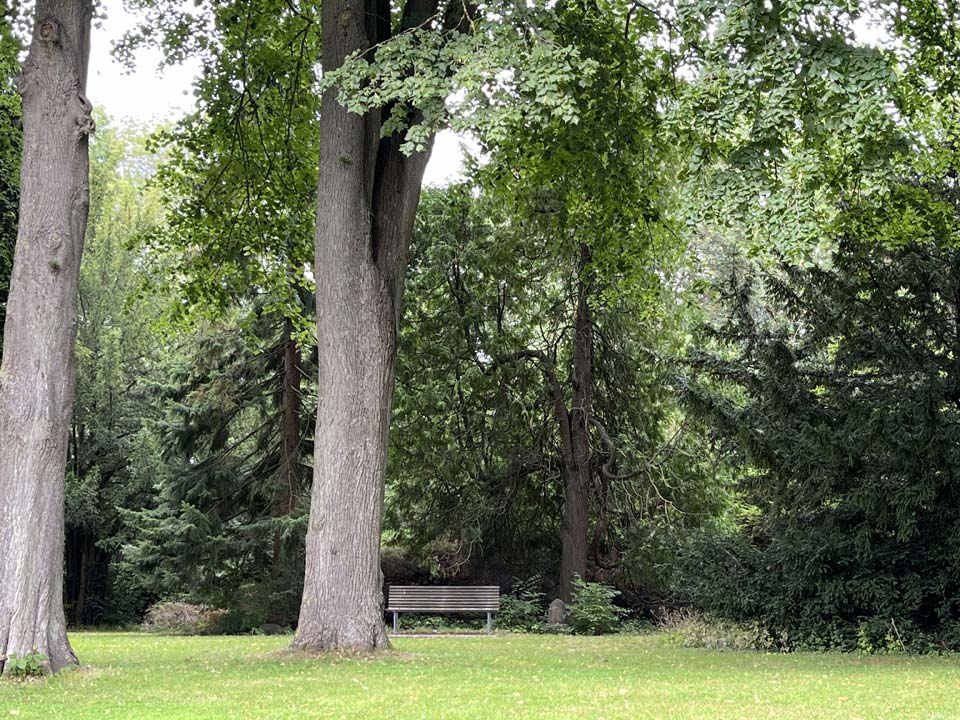
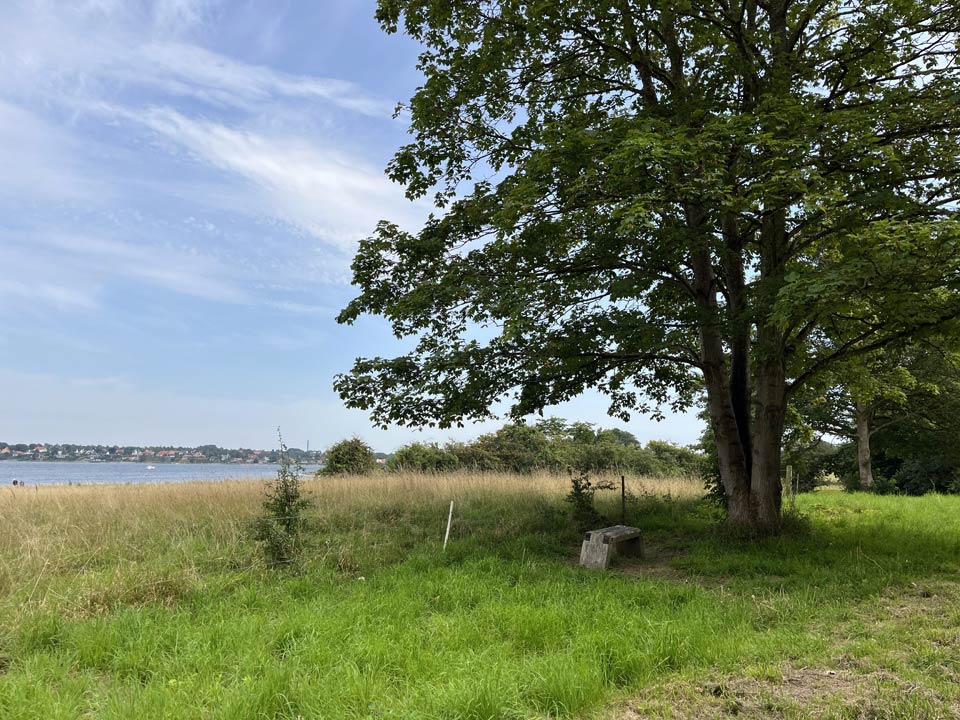
The audio walk is designed for a walk in the historic gardens of the area that was once Sankt Hans Hospital. The hospital was beautifully situated in a large park with views of the fjord. Markers are placed at benches with a QR code that you can scan to download the audio work to your mobile while strolling the garden, or you can sit on one of the benches and experience nature and sound merging.
The Project
Sct. Hans Have is pleased to present the audio walk “Om sorg” by the exciting and innovative artists – visual artist Astrid Gjesing and composer Sisse Lunøe.
The work takes as its starting point the two artists’ experiences of psychiatric hospitals and the places themselves. It is a sampling of texts from, for example, Rainer Maria Rilke and Sylvia Plath. To be sampled means it is clipped from others’ texts and reworked. It is voiced by six women.
Astrid Gjesing and Sisse Lunøe work with gravity and pain, but also with the good that (may) exist — and with hope. It is gripping, and they are able to use few, but powerful, means.
> om sorg < (”About Grief”, the Danish meaning of the title cannot be translated)
Here is my hope; here is my prayer.
Brought as a gift; a mirror image of my struggle.
I ask for your help.
Day after day, year after year. Three days, nine days, forty days…
and so it continues.
Heaven will meet Hell;
the light meets the darkness
like a small glimmer of hope in a dancing figure.
We shall not cease exploring,
and when all our exploration is finished
we will be where we began
and know the place for the first time.
This is the mind’s light, cold and planetary
The mind’s trees are black. The light is blue.
The grass lays its sorrows on my feet as if I were God,
stinging my ankles and muttering how small they are.
The Moon is no door. It is a face in itself,
white as bone and terribly agitated.
It drags the sea after it like a dark crime.
With completely hopeless, gaping jaws. I live here…
in a world that does not exist
so that it could exist
Shows her tall
tears trees and fields of blooming melancholy.
shows her the beasts of sorrow, which they graze — and often
a bird starts and draws, flying flat across their gaze, its stretched-out written
image of its lonely scream.
And higher, the stars. New. The stars of Sorrowland.
Gradually the complaint mentions them: “Behold:
The knight, the staff, and the fuller stellar image
they call: Wreath of Fruit. Then, toward the pole:
Cradle, road, the burning book, doll, window.
But in the late southern sky, pure as seen inward
by a blessed hand, the clearly shining M,
which stands for Mothers
I will go out to the cliff in the forest and
dress myself naked.
My breath’s fine mist,
the many sounds and things in the forest, echo, rustle,
soft whisper,
Love’s root, night light, chasms and vines
my heart’s pounding, blood and air
Earth with the moist, slumbering trees.
Earth, in the full moon’s cold, blue-tinged flood of light
Earth, with the tide’s strange swirl
Earth, in the white bloom of apple blossoms.
(Texts translated by AI are by Rainer Maria Rilke/Thorkild Bjørnvig; T. S. Eliot; Sylvia Plath/Peter Laugesen; Walt Whitman/Frederik Schyberg; Inger Christensen; Astrid Gjesing 2018)